


No time to read this? Why not find something to study instead? A1 – Beginner/Elementary | A2 – Pre-Intermediate | B1 – Intermediate | B2 – Upper-Intermediate | C1 – Advanced | C2 – Proficiency | What’s my level? | Italian level test
+++
Buondì.
We’re at the beach, plus Stefi and Bug have a dentist’s appointment this morning, so I’m writing this a couple of days in advance.
Long-time club members will know that I’ve done ‘Greetings from Sunny Rimini’ articles before, as my in-laws live there so the Adriatic coast is a regular getaway for us.
I wouldn’t have bothered with another one then, except that on Friday the Guardian Weekly published an article by Tobias Jones (lives in and writes about Italy), ‘Liberate the lidos!’ Who will win the war over Italy’s private beaches? (no paywall, but rather long), which I read with semi-approval, but which then got me thinking.
The gist of the article is that, while beaches in many European countries, including Britain, and probably in most other parts of the world, tend to be accessible to the public without charge – insomma, for the most part they are regarded as a ‘public good’ which anyone has the right to enjoy – that’s ceased to be the case in Italy.
Before you start to tut tut, as I did for decades, and as Tobias Jones is most certainly doing, read on.
Saturday morning Bug and I were at the ‘Parco della musica’, in Funo, which is about ten minutes’ drive from our house on the northern edge of Bologna.
Bug likes it because of the enormous slides, which are suitable for kids from 5 to 12 years, but at nearly three he can’t yet read the sign and, in any case, wouldn’t give a damn. Also because he usually makes a friend or two when he’s there.
This time we were the first to arrive, so Bug got to chase a rabbit into a hedge – from which it wisely refused to emerge. Next, looking around for someone to play with, he asked me “Dove è mio amico?”, meaning where’s the nameless child he’d met here a month ago.
Not much time passed and he was haring around with an eight-year-old called Michelangelo, until he got so excited he did ‘pipì’ in his ‘pantaloncini’. He’s supposed to stop and tell me that he needs to go, but when he’s having a good time he forgets. His new friend found the wet pants hilarious, anyway.
In the meantime, I’d been chatting to Michelangelo’s mamma and papà who, enough time having passed so it wouldn’t be impolite to ask, wanted to know where I was from (I have a strong English accent when speaking Italian), and then – hate this question – which PART of Britain, exactly?
Italians have never heard of Devon (principal cities: Exeter, Plymouth) as there’s no Premier League soccer team based there, still less Cornwall which, though scenic, is miles off the beaten track for visitors to London.
Knowing from long experience that explanations would just confuse (“Near Dover?” “Nope, that’s in the south-east. Cornwall is the extreme south-west…”) I pulled out my phone and showed them this photo:
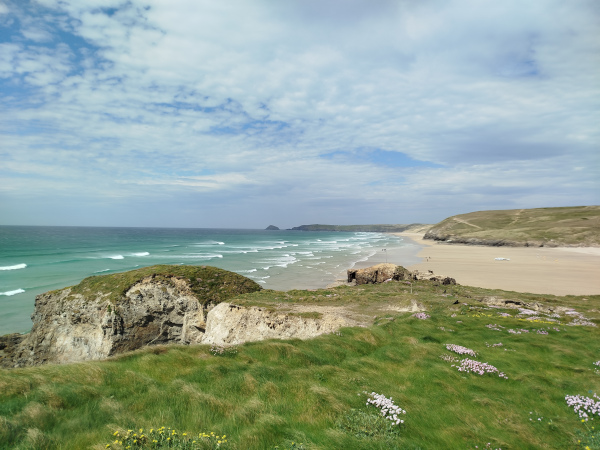
Perranporth beach, Cornwall, UK – photo is author’s own
To which their reaction was something like “Oh, what a beautiful FREE beach!” Unlike, it was implied, Italian beaches, which as Tobias Jones points out you have to pay to visit, or be content with the crowded, litter-strewn corner reserved for the impoverished. If there even is one.
Well – I started to explain – all or most beaches in Britain are free because of the tide, at which point I already knew I’d be wasting my breath. Their eyes glazed over. It was time to change the topic. And conveniently, Bug’s shorts were wet.
Here’s a picture of the beach we’re at this week:
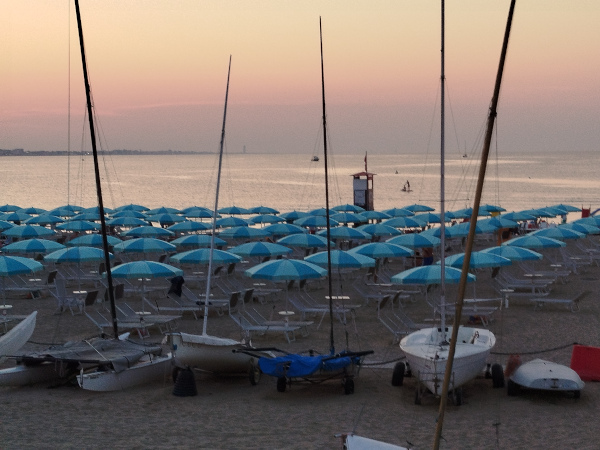
San Giuliano Mare beach, Rimini, Italy – photo is author’s own
Yes, you have to pay to use the umbrellas, but people mostly seem happy to and, as the beach concession owner interviewed by Jones points out, some pensioners book their spots for the whole summer then spend their days there, socialising with their friends.
And, the interviewee went on, they keep the beaches clean, provide toilets, facilities such as showers and children’s play areas, places to eat, and LIFEGUARDS.
That last point being disingenous, as no one ever drowns in the Adriatic, which is shallow and flat.
Sure, in France they have no beach concessions and lots more people drown. But that’s not a casual relationship. Most of France’s coast is the channel (the ENGLISH channel) or the Atlantic, so big, dangerous waves. The risk of drowning there is ever-present. Anzi, it’s half the fun!
But anyway, back to the obvious explanation that no one notices.
Italy’s beaches: covered in umbrellas and bars / Cornwall’s beaches: ‘free’, as Italians would put it.
Explanation? It’s not so much evil capitalists or corrupt local councils.
Think of a building with two or more storeys. Maybe the house you live in, or the office or school you work in. The average height of a storey in a building is 9-10 feet (call it three meters).
On the Adriatic coast at Rimini the tidal reach – so the level of the sea between the minimum and maxium heights – is approximately two feet, so not much higher than most people’s knees. Enough to drown a medium-sized dog say, were you to unkindly stake it to the sand and wait six hours.
On the north coast of Cornwall, at Perranporth, the tidal reach is 13-18 feet (four meters plus). From low tide to high tide the water rises from ground level to the floor above, then half-fills your bedroom with sewage solution.
Oh, and most of the beach disappears.
Actually there is a concession on Perranporth beach (a pub, naturally), but it’s way, way back, near the dunes, where the sea can’t reach it.
No fixed umbrellas, though. Families bring their own, sometimes hauling wagons full of beach gear all the way from the carpark to the waves, which can be a ten minute walk when the tide is far out.
Tides, their presence or absence, basically explain beach culture and economics in any two places you’d care to compare. You don’t need to be a rocket scientist to figure it out. Yet no one ever mentions it.
Beaches in a Britain are a public good because they’re washed over by a storey or more of big waves several times a day. Not good umbrella/beach bar territory, then.
Beaches in Italy, in contrast, experience such insignificant tides that planting umbrellas all the way down to a few meters from the water makes sound commercial sense, and can be done once then left for the whole season.
While I’m on the subject of obvious explanations no one ever mentions, you’ll have heard, no doubt, that young people in Italy are shamelessly dependent on their parents, often living at home until their mid-thirties (or longer!), not having the initiative to find a place of their own, won’t stand on their own two feet, et cetera, et cetera.
All of which is mostly true, but there’s an obviously explanation, and it has nothing to do with lack of initiative or the price of flatshares. Or tides, for that matter.
Inheritance law.
Don’t yawn, it’s interesting, and explains a lot about Italy compared to where you live.
Basically, in Britain, the USA, and the northern part of Europe, you can choose to leave your money and assets to whoever you please.
Should grandpa decide to leave his whole pile to a new and extremely young wife, rather than to his deserving children and grandchildren, well that’s entirely his choice. Good luck to him! It’s his money anway, isn’t it.
I don’t know how you were brought up, but when I was a youngster I knew I’d have to work for a living, pay rent and taxes, that there would be no free ride. That was the way things were, and are. At the very least, it was motivating.
On the plus side (though it’s debatable) being financially independent from an early age, thanks to bank accounts and credit cards marketed to eighteen-year-olds, and the availability of work, meant I could do what I wanted, and didn’t have to listen to my parents’ nonsense any longer.
On the negative side, that meant I was working bullshit jobs instead of studying, living in squalid conditions, eating crap, and piling up credit card debt.
In Italy, in contrast, ‘nonno’ (grandpa) is only permitted to leave a proportion of his ‘beni’ (assets) to his flirty new blonde ‘badante’ (live-in care assistant).
Thank goodness, think his daughters and grandchildren, who will sooner or later get their hands on the lion’s share of the loot. Perhaps a viagra prescription would hasten things along, they wonder.
I can’t stress this enough: IN ITALY MONEY PASSES DOWN THROUGH THE GENERATIONS. It stays within the family. That’s the natural, only way. Everyone knows.
Which means, typically, that their parents helped them, so they help their kids, and the kids will help their kids, if they have anyway, which they damn well should, as it’s their primary function.
When I had three young children in Italy, several decades ago, people used to tell me how BRAVE I WAS.
Not because of the kids themselves, messy and noisy though they were, but because I’d taken on the obligation to buy each of them a home at some point in their future. “I could never afford three!” people would tell me, assuming I was some sort of millionaire.
People thought they knew that my parents and in-laws had stumped up for our home (they did help, but so did a thirty-year mortgage), and that I would therefore do the same for my kids.
Which means no student debt (Americans, Brits, imagine that!), no credit cards or mortgages aimed at the young, no pressure to get out of bed and earn some cash. Studying is important, obviously, but so is enjoying yourself while you’re young. After all, your parents did. Back in the day it was all discos and reefers, so we hear.
The flip side is less independence.
For instance, Italians rarely move cities for work. When you buy a home in Italy (with your family’s help), or inherit one, or live in one that your parents inherited and let you have rent-free, why would you want to leave your home-town buddies to chase a career in the expensive big city where you don’t know anyone, only to have to spend your ‘stipendio’ (salary) on rent, instead of shiny cars, nice clothes and foreign holidays?
As I recall it – from way back in the ‘eighties – life in my teens and twenties was insecure, lonely (moving a long way from home) and a financial grind. I was prone to making dumb decisions. I had a very short-term outlook on life. That was no one’s fault. It was the way it was then, for a lot of people at least.
Whereas my Italian wife was supported by her parents, which – as she tells it – was a fairytale existence. At least up to the point at which she met me.
When I first moved to Italy, my future Italian father-in-law gave me a Vespa so I could get to work more easily. When, later, I bought myself a elderly BMW (motorbike) with my earnings, he took it back. Fair enough.
But when the birth of our first child was due, he bought us a car, which he also took back later. It was years until we needed to buy one for ourselves.
At the time I thought of it as absurdly, pleasingly generous. I was grateful, and still am. No one had ever been so kind.
But now, I realise, it’s just the system.
What’s ‘mine’ is, in fact, ‘ours’. Assuming we understand ‘ours’ in a temporal, generation-to-generation sense. This apartment was my mother’s father’s, now it’s yours, and one day it’ll by my grandchildren’s.
I get that the Italian system might seem absurd to many people reading this. And sure, being bound to your family, including those not yet born, has its drawbacks.
But understand this: people from ‘the kids will get everything anyway, so why make them pay rent and take out debt?’ countries, such as Italy, don’t understand your system, your experiences, your priorities any better than you appreciate theirs.
The tide / inheritance law explain a lot of things. But people don’t notice.
Why are there no umbrellas on Perranporth beach?
Why do British parents let their children take out loans to study at college?
Italians scratch their heads and think: what a crazy world!
Alla prossima settimana.
P.S.

And here’s another reminder to read/listen to Tuesday’s bulletin of news from EasyItalianNews.com.
Reading/listening practice will help you consolidate the Italian you’re studying, expand your vocabulary, and build vital comprehension skills.
EasyItalianNews.com is FREE to read/listen to.
Subscribing, and so receiving all three text + audio bulletins of ‘easy’ news via email each week – on Tuesdays, Thursdays, and Saturdays – is also FREE.
Just enter your email address on this page and click the confirmation link that will be sent to you.
+++
OnlineItalianClub.com | EasyItalianNews.com | Shop (ebooks) | Shop (online lessons)
OnlineFrenchClub.com | OnlineSpanishClub.com | OnlineGermanClub.com
+++
No longer interested?
All bulk emails we send (including this one) contain an unsubscribe link, usually at the bottom. Scroll down to find it, click the link and select ‘unsubscribe’. That will permanently remove your email address from our mailing list.
Fiona Spencer says
Another fascinating article Daniel. Thankyou and try taking it easy for a while.
Daniel says
Grazie Fiona!
Felice says
Allorra, non avete tasso dell ‘inheridità in Italia???
Daniel says
4% for spouse, kids etc. if estate is over one million euros, other rates for more distant relatives, costs for transfering property (as always)… See https://www.agenziaentrate.gov.it/portale/schede/pagamenti/imposta-di-successione/aliquote-e-franchigie
People we know (not us) buy homes for their little ones in the kids’ names, then register the little darlings as living there, so to benefit from ‘first home’ exemptions on stamp duty and utility costs. It’s a big saving.
Obviously each person can only own one ‘first home’, so the family’s assets are spread out between family members early on. Besides minimising taxes and bills on purchase, that would help with the inheritance tax threshold were there any danger of exceeding it.
I could go on and on about this topic as, besides inheritance, there are loads of other interesting differences between the Italian and British systems. For instance, before marriage you’re required to specify if each spouse’s assets will be held in their own name or ‘in common’, which is a way that wealthy families keep the money in the bloodline, so to speak, safe from future divorce settlements. A sort of Italian pre-nup.
Patricia says
Love this article, the love it represents and how much sense it makes. I think it’s only logical but I can also understand it might be like trying to explain the difference between socialism and communism to people in the U.S. Thanks for posting it. It cheered me right up so much that I don’t care if I make pipi in my pantaloncini!
Daniel says
“trying to explain the difference between socialism and communism to people in the U.S”
or the similarities between Christianity and Islam, for that matter. Religious people are much the same the world over, in my experience, but may fail to recognise their own behaviour when expressed by others i.e. respect for family, community, tradition, etc.
Thanks for commenting, Patricia.
Lynne F says
Another brilliant article Daniel thanks . The initial words about the beach caught my attention. Our recent move finds us a short distance from sand dunes and sandy beach but the sea is little shy , 1-1.5 km from the promenade. Perhaps that is why we have the second longest pier in the country. Still we don’t need to go to the beach though about 1cm below the surface our garden is pure sand . 😄
Daniel says
Bet that’s great for people who like long walks!