


No time to read this? Why not find something to study instead? A1 – Beginner/Elementary | A2 – Pre-Intermediate | B1 – Intermediate | B2 – Upper-Intermediate | C1 – Advanced | C2 – Proficiency | What’s my level? | Italian level test
+++
Buondì.
Last week I wrote about repairing the club website, which was suddenly missing all its accented Italian characters, so è,é,ò,à,ù and ì. I think that’s the lot. Hope so, anyway.
You can read the article here if you missed it: Oops! Where did all the Italian accented characters go?
E poi, while pottering about the clubhouse a day or so after publishing that, I tripped over our Italian level test and discovered that – how possible after my repairs? – it was STILL missing all its accented characters.
Which was embarassing, as many of the forty questions in the test made no sense whatsover without the accented characters, for instance è (meaning ‘is’) and critical prepositions like à (‘to’). Both single-accented-character words had just disappeared!
I’d come across a note that a club member had emailed about the issue a while back, which I’d then filed in a place where I would remember to act urgently on it, which I then forgot to do. It was probably Bug’s fault. Most things are these days, joy that he is.
Hence the test was broken BEFORE the recent crisis, and the emergency repairs described in last week’s article had no effect, as they were based on restoring backups and fixing those, and the backup for the level test was broken already, as I’d been told but forgotten.
Tutto chiaro? Anyway, I ended up having to go over all the level test’s forty questions (and 160 answers) restoring the è,é,ò,à,ù,ì characters as needed. Which was a workout for my Italian, and not in a good way.
A word about level tests, though not only ours.
A level test is basically a diagnostic tool: it is to language teachers what a thermometer is to medics.
Italians are obsessed with taking their temperature, by the way, and the degrees or half-degrees of Celsius that their home (or even personal) thermometers show when used to verify how they are feeling today, dictate their subsequent actions in a way which cannot be questioned.
36.5 C? You’re fine, but maybe better to check again in an hour or two, just to be on the safe side?
37 C? Oh dear…
37.5 C? If we took you to school, they’d totally refuse to admit you. And they’d call Social Services as soon as we’d reluctantly agreed to take you home again. This is a disaster!
38 C? You’re ill, kid. Stay in bed, keep warm, and eat only white things (don’t ask…) Never mind, though, I can phone my own ‘medico di famiglia’ right away and get three days off work, to look after you.
38.5 C? Still waiting for the ‘pediatra’ to pick up. We need an urgent appointment!
39 C? We’re going to the emergency department. Yes, I know it’s three a.m.
My explanation, twenty-six years ago when I was first a parent in Italy, that we possessed no thermometer but having pressed my palm to my baby daughter’s forehead I thought that she seemed a little warm, was met with INCREDULITY.
How could I myself have survived to adulthood without constantly measuring my temperature? How could I hope to bring up a child that way?? Barbarism.
So anyway, level tests are diagnostic tools, and just as a ‘pediatra’ knows there’s nothing wrong with a child who’s tearing around her office trashing things while the parents anxiously and at length list their darling’s symptoms, so too can an experienced teacher make a pretty accurate guess about your level as soon as you open your mouth.
Our forty-item test, by the way, was designed on the basis that an educated native speaker who was paying full attention might get all the answers correct, as might a particularly anal-retentive and grammar-obsessed student of Italian, assuming all the accented characters were in place.
The test says absolutely nothing about the test-taker’s ability to speak or write Italian, or to read and understand more extensive authentic texts, such as newspapers.
Which are, of course, my strong points.
I never took an Italian course, or studied the grammar, beyond a handful of irregular verbs. I’ve found that ignoring rules and their many exceptions has served me well over the past quarter century. At least I’ve managed to get on with my life in the meantime.
But I got a lousy result on our own level test, for that reason. I don’t recall the score, but it wasn’t great. You could probably do better…
Anyone relying on my result would rightly conclude that my grammar was patchy (at best), though without meeting me they’d likely guess poorly regarding my ‘real’ Italian level. Which might also be true if any of my Italian neighbours took the same test.
‘Serious’ level tests, of course, will – at a minimum – contain stuff that isn’t just tricky grammar nonsense, for example reading comprehension texts and, ideally, some listening. And the results will be interpreted only during a spoken interview conducted by someone who knows what they’re doing. Just as a competent ‘pediatra’ does, when dealing with fussy parents and their vaguely warm offspring.
But there’s the trade-off: the more complete and balanced the test, the longer it takes to administer.
There are also other issues. People who are used to taking or administering tests benefit from a performance gain compared to others who aren’t. Having administed thousands of language tests over my thirty-plus teaching career would give me an advantage were I to do one myself. Years back I aced the A2 (pre-intermediate) Swedex exam, for instance, having mostly ignored Swedish grammar but carefully studied how the test itself was designed and scored.
More to the point, why bother with precision in the first place? When it comes to thermometers, the difference between 36 C and 45 C is literally a matter of life or death – a tenth of a degree one way or another in a reading will make little difference.
Medical thermometers are designed with this in mind, of course. They don’t got down nearly as far as freezing point, or up far enough to certify that a patient is cooked all the way through and safe to eat.
If we’re talking ‘level test’ as a tool for placing new students in the ‘right’ class – something that all language schools need to do – then too much precision can be as unhelpful as too little.
It’s rare that a school will offer more than one class per level, for instance (though perhaps splitting the weakest students into ‘beginner’ and ‘elementary’ groups), so if there are six-to-eight approximate levels, any test that shows results in precise percentage points is not helping much.
Moreover when ‘placing’ students (level tests are often known as ‘placement tests’), experienced educators need to take into account both a student’s preferences and goals (wants to/doesn’t want to start with the basics and progress at a relaxed pace) but also those of others in the class.
Swedish people learning Italian in Sweden (what’s known as a ‘monolingual’ group) are likely to have similar backgrounds and objectives to others in the class (a similar age, too.) But were one of them to come to our Italian school in Bologna (to study in a ‘multilingual’ group) we’d need to place them with other students of different nationalities and ages, who’d necessarily have had different language-learning experiences, and might also have very different objectives.
Insomma, ‘placement’ testing is more of an art than a science, besides needing to be done rapidly, in real time, and as effectively as possible (or complaints will result…)
‘Level’ testing, on the other hand, means nothing without some understanding of the test taker’s purpose. Why are we doing this? What’s the point? How will it help? And, of course, the test design needs to be appropriate to the purpose or purposes.
I’m out of time. Take a look at our newly-repaired Italian level test if you’re so inclined, but don’t feel bad if you don’t do well on it (I didn’t…)
A better way of measuring your progress, at least for me, is to use graded material such as the FREE listening material on the club website or our (not free) ‘easy reader’ ebooks. We have hundreds of them, and the free sample chapters on the Catalog page should give you an approximate idea of your reading/listening level (which may be different, probably will be…)
Start with ‘easy readers’ designated as being below what you understand to be your current level (look here), and work your way up gradually until you get to the free samples that are ‘too difficult’ to read and/or to listen to. At which point, step down a half-level and begin there. As your reading/listening skills improve, step up again, half-level by half-level, to infinity and beyond.
Così. Gotta go, really this time.
There’s a half-price ebook offer below, by the way.
And also GRAZIE MILLE to all the happy EasyItalianNews.com readers who sent donations during their recent appeal. It went really well, apparently.
Alla prossima settimana, allora!
Half-Price Easy Reader Ebook: ‘Natale a sorpresa’ (B2) £4.99
This month, as things slow down in the run up to the holidays, why not use any slack time that comes your way to build your Italian reading/listening skills?
In December 2025 EasyReaders.org will be offering half-price deals on their three seasonal ‘easy reader’ ebooks. First off is B2-level ‘Natale a sorpresa‘.
Read/listen to the eight short chapters over the next week or two and you’ll start feeling all Christmassy, while at the same time improving your Italian comprehension skills, and consolidating the grammar, and vocabulary you’ve studied.
Win, win, win, and at half the usual ‘easy reader ebook’ price!
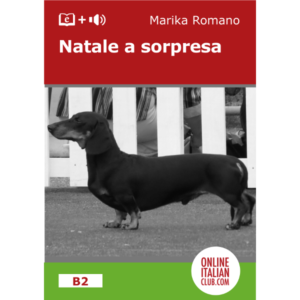
Matteo’s supposed to be writing a book – he has a deadline coming up – but he’s suffering terribly from writers’ block. All he can do is stare at a blank computer screen. He’s recently out of a relationship, which hasn’t helped…
Worse, it’s December and Christmas is coming! Normally Matteo spends the festive season with his family, but this year they’re visiting relatives in Australia. So it looks as if he’ll be celebrating alone.
Then he has an idea. He’ll call his best friend Filippo, who’ll surely be able to help! Perhaps they can spend Christmas at Filippo’s place in the mountains, or take a trip somewhere…
- .pdf e-book (+ audio available free online)
- .mobi (Kindle-compatible) and .epub (other ebook readers) available on request at no extra charge – just add a note to the order form or email us
- 8 chapters to read and listen to
- Comprehension questions to check your understanding
- Italian/English glossary of ‘difficult’ terms for the level
- Suitable for students at intermediate level or above
- Download your Free Sample Chapter (.pdf)
Remember, this month Natale a sorpresa is 50% discounted, so just £4.99 rather than the usual ‘easy reader’ ebook price of £9.99!
Buy Natale a sorpresa just £4.99! | Free Sample Chapter (.pdf) | Catalog
Find more ebooks, organised by level, then type: A1 | A1/A2 | A2 | A2/B1 | B1 | B1/B2 | B2 | B2/C1 | C1 | C1/C2 | C2
How do I access my ebook?
When your order is ‘completed’ (normally immediately after your payment), a download link will be automatically emailed to you. It’s valid for 7 days and 3 download attempts so please save a copy of the .pdf ebook in a safe place. Other versions of the ebook, where available, cannot be downloaded but will be emailed to people who request them. There’s a space to do that on the order form – where it says Additional information, Order notes (optional). If you forget, or if you have problems downloading the .pdf, don’t worry! Email us at the address on the website and we’ll help. Also, why not check out our FAQ?
P.S.

And here’s the usual Wednesday morning reminder to read/listen to Tuesday’s bulletin of news from EasyItalianNews.com.
Reading/listening practice will help you consolidate the Italian you’re studying, expand your vocabulary, and build vital comprehension skills.
EasyItalianNews.com is FREE to read/listen to.
Subscribing, and so receiving all three text + audio bulletins of ‘easy’ news via email each week -on Tuesdays, Thursdays, and Saturdays – is also FREE.
Just enter your email address on this page and click the confirmation link that will be sent to you.
+++
OnlineItalianClub.com | EasyItalianNews.com | Shop (ebooks) | Shop (online lessons)
OnlineFrenchClub.com | OnlineSpanishClub.com | OnlineGermanClub.com